
Hey Health Techies!
By now I’m sure you’ve heard about the AI prescribing pilot in Utah. The Beehive State has launched a first-of-its-kind pilot with Doctronic, an AI-powered health platform, to let an autonomous AI system legally participate in renewing prescriptions for select medications. Imagine a world where getting your routine prescription renewal doesn’t involve an inbox message or call to the pharmacy. Sounds good in theory…
But this isn’t just automation. It’s clinical decision-making without a human doctor signing the script, and it’s already reshaping the conversation about where health tech fits into everyday care and honestly whether or not we’re automating the right things.
Ok so what’s this all about?
Earlier this month, Utah went live with a first-in-the-nation pilot that allows an AI system developed by Doctronic to renew certain prescription drugs for patients with chronic conditions without clinician oversight.
Patients can now use Doctronic’s AI to request refills online — often in minutes instead of days or weeks.
The AI handles renewals for roughly 190 commonly prescribed medications but excludes controlled substances, narcotics, stimulants, and antibiotics for short-term illness.
Initial safeguards include physician review of the first set of refills and escalation back to clinicians when the AI isn’t confident.
The goal? Reduce delays that contribute to non-adherence, ease clinician workload, and provide faster access to medications for people managing chronic disease.
📈 Why this matters
Prescription renewals account for a huge portion of medication activity, and delays in getting refills can directly contribute to worsened outcomes (and avoidable healthcare costs). The pilot aims to test whether AI can step in safely and efficiently, while gathering data on patient experience, safety outcomes, workflow efficiency, and cost impacts.
In addition to the cost savings, a data set provided by Doctronic to Utah regulators, showed that in a comparison of its AI with clinicians in 500 urgent care cases, 99.2% of the time, the AI’s treatment plan matched the physicians’ recommendations.
In fact, Dr. Adam Oskowitz, co-founder of the company even touted the AI as being “better than doctors at doing this” according to a Politico article.
⚠️ Debate & skepticism
Of course the pilot isn’t without some scrutiny.
Some clinicians have called out that removing doctors from decision loops could miss nuance or subtle clinical concerns until it’s too late.
Others question whether the term “AI doctor” might blur public understanding of what AI is and isn’t in clinical practice.
I saw pharmacists questioning why this type of work was prioritized when pharmacists have been capable of doing it all this time but in most cases saw little regulatory traction to make it happen.
And still others wondered very simply, would it go too far? Refilling meds that are meant for short term use. I did confirm with Doctronic that antibiotics are not a part of the 190 medications in the pilot.
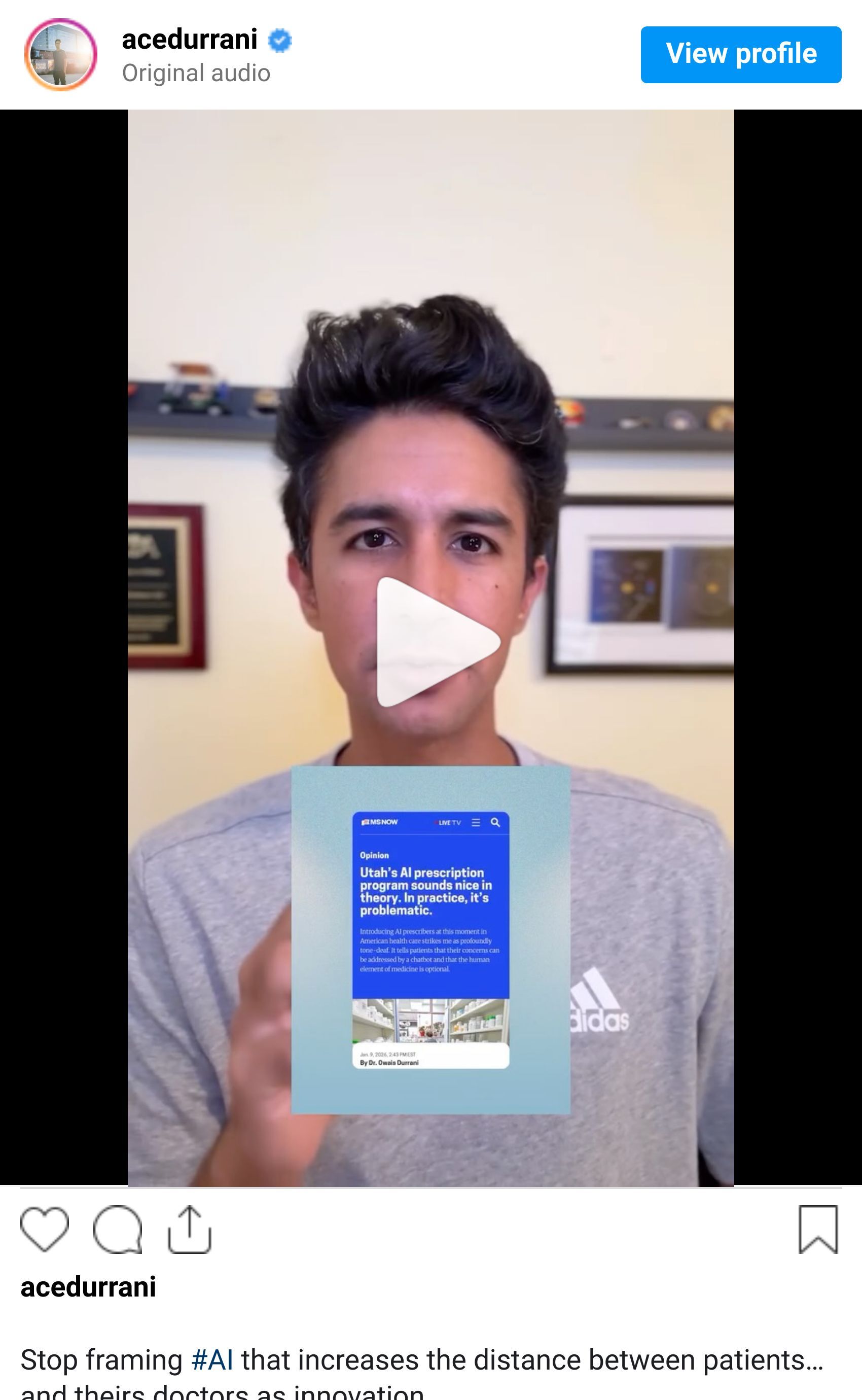
The post below by Dr. Durrani on Instagram raised the very important point that this technology feels like a use case that is widening the gap between patients and providers when the goal is to use technology to bring them closer. I couldn’t agree more.
👀 What to watch next
This pilot will be closely tracked over the coming months. Will policymakers use the data to expand autonomous AI roles? Will other states follow suit? And how will clinicians and patients weigh convenience with all of the unknowns?
And just this past week, Doctronic doubled down by introducing their concierge product called Checkup. They say it includes bloodwork, refills, and AI-powered evidence based care.
One thing’s clear: this isn’t just a Utah experiment, it’s a national conversation starter about where AI fits into the future of healthcare delivery. And we’re just getting started.
📰 Weekly Wrap-up
OpenEvidence now valued at $6 billion after $200 million Series C
📌 Job Board
Don’t miss these open roles 👀
Clinical Content Analyst - Cohere Health
Project Manager - Judi Health
Clinical Operations Specialist, Quality & Outcomes - Midi Health
and more!
Until next time,
Lauren
